
SEAS operative working inside an asbestos removal enclosure
Pictured
Licensed asbestos removal by SEAS, Starfish Construction's environmental and asbestos division
SEAS asbestos management
Home › Resources › In Focus › Asbestos Management Guide

The Complete Guide to Asbestos Management

for Building Owners and Duty Holders

What the duty to manage asbestos means, how surveys, licensed removal and clearance work and how to plan asbestos safely into refurbishment, remediation and redevelopment. Written by SEAS, our HSE-licensed environmental and asbestos division.

Reviewed by
Jamie Purdon, Asbestos Director, SEAS
Last reviewed
October 2026
Reading time
14 minutes
At a glance

Five things every duty holder should know about asbestos

Asbestos is still present in many buildings constructed or refurbished before 2000. These points summarise the guide; each one is expanded below.

  • Asbestos-related diseases still cause around 5,000 deaths a year in Great Britain, mostly from past exposure.
  • If you are responsible for maintaining or repairing non-domestic premises, you have a legal duty to manage the asbestos in them.
  • A management survey is for normal occupation. Before refurbishment or demolition, a more intrusive refurbishment and demolition survey is normally needed.
  • Most work on higher-risk materials must be done by a contractor holding a licence from the Health and Safety Executive (HSE).
  • After licensed removal, an independent accredited analyst must confirm the area is safe before it is reoccupied.
01

Why asbestos is still a risk

In short

Asbestos was widely used in UK buildings until it was banned in 1999. Materials in good condition can often stay in place under a suitable management plan, but when asbestos is damaged or worked on it releases fibres that can cause fatal diseases decades later.

Any building constructed or refurbished before 2000 may contain asbestos. Common materials include asbestos insulating board in ceilings, partitions and soffits, sprayed coatings and lagging, textured coatings, floor tiles, cement roof sheets, gutters and downpipes.

The risk arises when these materials are drilled, cut, broken or deteriorate. That makes refurbishment, roofing, remediation and demolition the times when the risk is highest, and when good planning matters most.

Where asbestos is commonly found

  • Ceiling tiles, partitions, soffits and fire doors (asbestos insulating board)
  • Pipe lagging, boiler insulation and sprayed coatings
  • Textured coatings on walls and ceilings
  • Floor tiles and adhesives
  • Cement roof sheets, cladding, gutters and flues
  • Soil and made ground on former industrial sites
5,000
Asbestos-related deaths a year in Great Britain (HSE estimate)
2,218
Mesothelioma deaths in Great Britain in 2023 (HSE)
1999
The year asbestos use was banned in the UK
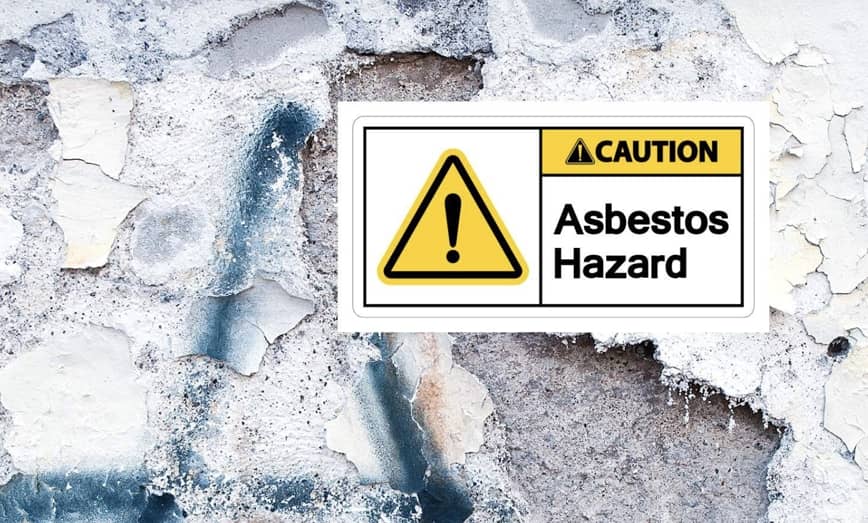
Asbestos hazard warning sign on a deteriorating wall
Damaged or deteriorating materials need assessing before any work starts. Asbestos investigation
02

The duty to manage asbestos

In short

Under regulation 4 of the Control of Asbestos Regulations 2012, the person responsible for maintaining or repairing non-domestic premises has a legal duty to manage asbestos in them. The duty also covers the common parts of residential blocks.

The duty holder may be the building owner, a tenant with repair obligations, a managing agent or another organisation with clear responsibility for maintenance. Where responsibility is shared, everyone involved must cooperate.

The duty is about managing risk, not removing every trace of asbestos. Materials in good condition can often be left in place, labelled and monitored, as long as everyone who might disturb them knows where they are.

Asbestos management services

What the duty holder must do
01
Find out whether asbestos is present
Its amount, location and condition.
02
Presume materials contain asbestos
Unless there is strong evidence that they do not.
03
Keep an asbestos register
An up-to-date record of the location and condition of known and presumed asbestos.
04
Assess the risk
How likely anyone is to be exposed to fibres.
05
Write and follow a management plan
Review it at least every 12 months, or sooner if things change.
06
Monitor condition
Check materials left in place regularly.
07
Share the information
With anyone who may work on or disturb the materials, including contractors and the emergency services.
03

Asbestos surveys and registers

In short

An asbestos survey finds and records asbestos-containing materials so they can be managed safely. The type of survey depends on what is going to happen to the building.

Management survey

Needed for the normal occupation and use of a building. It locates, as far as reasonably practicable, asbestos that could be damaged or disturbed during everyday activities and foreseeable maintenance. It may involve minor intrusion and sampling.

Refurbishment and demolition survey

Needed before any refurbishment or demolition work. It is fully intrusive within the area of the planned work, so that all asbestos can be found and dealt with before work starts. The area normally needs to be vacated during the survey.

What a good survey report gives you

  • A register of asbestos-containing materials, with locations on plans
  • Sample results from an accredited laboratory
  • A material and priority assessment for each item
  • Photographs and clear labelling references
  • Recommendations for management, repair or removal
  • Any areas not accessed, and the reasons

Surveys should follow HSE guidance (HSG264) and be carried out by competent, accredited surveyors. The findings feed directly into the asbestos register and management plan.

Our guide to building surveys

Jamie Purdon, Asbestos Director, SEAS, Starfish Construction
“We’re seeing the effects of legacy inaction, where asbestos was overlooked, mismanaged or simply misunderstood. We help clients face the issue with clarity, providing insight, and supporting asbestos management and compliance.”

JAMIE PURDON
ASBESTOS DIRECTOR
SEAS, STARFISH CONSTRUCTION

04

Licensed, notifiable and non-licensed work

In short

The law grades asbestos work by risk. The highest-risk work must be carried out by an HSE-licensed contractor, lower-risk work may be notifiable and some short, low-risk tasks can be done by trained workers without a licence.

The category depends on the type of material, its condition, how it will be worked on and the likely level of exposure. The decision should be made by a competent person after a risk assessment, and it shapes the whole method of work.

Highest risk

Licensed work

  • Most work on sprayed coatings, lagging and asbestos insulating board
  • Must be done by an HSE-licensed contractor
  • Notified to the enforcing authority at least 14 days before work starts
  • Enclosures, air monitoring and four-stage clearance
  • Workers under regular medical surveillance
Medium risk

Notifiable non-licensed work

  • For example, short work on deteriorated asbestos cement or textured coatings
  • Notified to the enforcing authority before work starts
  • Workers need medical examinations and records must be kept
  • Carried out by trained workers with suitable controls
Lower risk

Non-licensed work

  • Short, low-exposure tasks on materials in good condition
  • Trained workers following a written method
  • Suitable controls, protective equipment and waste handling

In all cases, asbestos waste is hazardous waste. In England and Wales it travels with a hazardous waste consignment note, and in Scotland with a special waste consignment note, to a suitably permitted site.

05

How licensed removal works

In short

Licensed asbestos removal follows a controlled sequence designed to stop fibres escaping, protect the workforce and prove the area is safe before anyone else returns.
01
Survey and scoping
The refurbishment and demolition survey is checked on site so that no materials are missed.
02
Plan of work and notification
A written plan of work and risk assessment; licensed work is notified 14 days ahead.
03
Enclosure
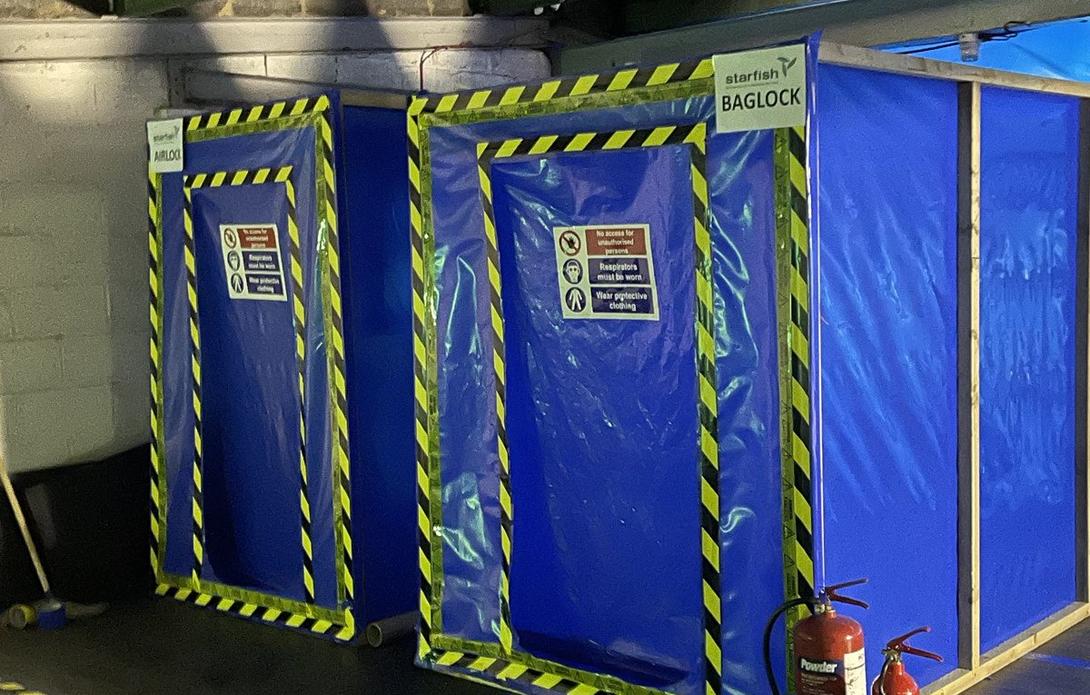
The work area is sealed in a negative-pressure enclosure, with an airlock and a bag lock for waste.
04
Decontamination
Operatives use a hygiene unit to decontaminate whenever they leave the enclosure.
05
Removal and waste
Materials are removed with controlled wetting and suppression, double-bagged and taken to licensed disposal.
06
Air monitoring
Air is monitored throughout, both outside the enclosure and for the workforce.
07
Four-stage clearance
An independent, UKAS-accredited analyst inspects the area visually and by air testing before issuing a certificate for reoccupation.
Negative-pressure asbestos removal enclosure with warning signage
Enclosures keep fibres contained while removal takes place. Whisky warehouse project
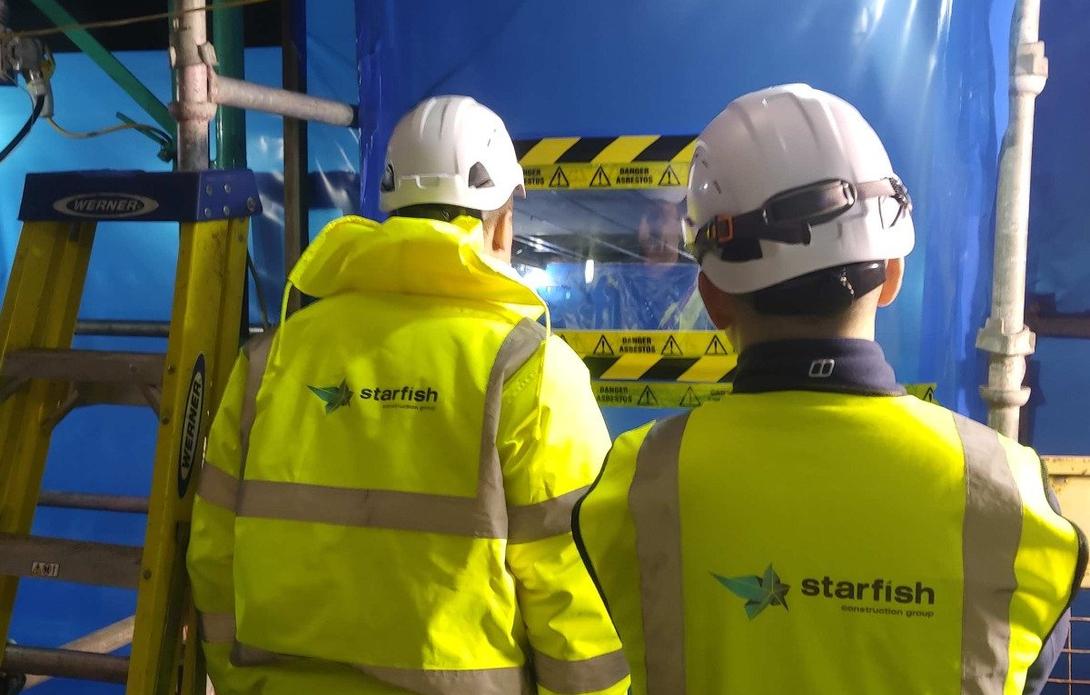
SEAS operatives at the entrance to an asbestos enclosure
Licensed removal at an operational whisky bonded warehouse.
Asbestos left undisturbed is managed.
Asbestos disturbed without a plan is a hazard.
06

Asbestos in refurbishment and remediation

In short

Most asbestos is found and disturbed during other projects: roofing, RAAC remediation, façade work and refurbishment. Planning asbestos into the programme from the start avoids delays and keeps everyone safe.

Older roofs, soffits, fascias and ceilings often contain asbestos insulating board or asbestos cement, and RAAC buildings of the same era frequently do too. If asbestos is discovered after work starts, the site stops until it is surveyed and removed, which delays the programme and adds cost.

Good practice on refurbishment projects

  • Commission a refurbishment and demolition survey early, before the design is fixed
  • Sequence licensed removal before follow-on trades start
  • Build enclosure, access and temporary roof needs into the programme
  • Plan for occupied buildings, such as schools in term time or working warehouses
  • Keep clearance certificates and waste records for the building file

The Complete Guide to RAAC

Example: a working trade warehouse

At a plumbing and heating trade centre, SEAS removed 340 m² of asbestos insulating board ceiling tiles as part of the client's asbestos management programme. The warehouse layout required careful positioning of the enclosure, airlock and bag lock, with access created from the mezzanine level.

  • Delivered on programme, with no contract variations
  • An HSE visit completed without issue
  • Four-stage clearance confirmed the area safe for reoccupation
07

Contaminated land and derelict sites

In short

Former industrial and derelict sites can contain asbestos in soil and buildings alongside other legacy contaminants. Understanding the risks early protects people, unlocks redevelopment and can open the door to tax relief.

Buried asbestos waste, fragments of asbestos cement and fibres in made ground are common on brownfield sites. They are often found alongside hydrocarbons, heavy metals and other chemical residues from previous uses.

Derelict buildings bring further risks: vandalism, fire and deterioration can damage asbestos and spread contamination, leaving owners exposed to enforcement and liability.

What a remediation strategy includes

  • Desk study and site investigation, including soil sampling
  • Risk assessment for future use of the site
  • Removal, treatment or containment of contaminated material
  • Controlled demolition with asbestos removed first
  • Verification records for planning and building control
  • Securing and monitoring derelict buildings

Land Remediation Tax Relief

08

Choosing an asbestos contractor

In short

Most asbestos removal must be carried out by an HSE-licensed contractor, and lower-risk non-licensed work still needs trained, experienced people. A few simple checks protect your people, your building and your legal position.

Use these questions when appointing a contractor for asbestos surveys, removal or remediation.

01
If the work is licensable, do they hold a current HSE asbestos licence?
You can check the HSE register of licence holders. Licences are normally granted for up to three years.
02
Are they members of a recognised trade body?
For example, the Asbestos Removal Contractors Association (ARCA).
03
Is the analyst independent?
The four-stage clearance should be carried out by a UKAS-accredited analyst appointed independently of the removal contractor.
04
Can they show a plan of work for your site?
Expect a site-specific plan, not a generic method statement.
05
How will waste be handled?
Ask for consignment notes and confirmation of the receiving site.
06
What records will you receive?
Clearance certificates, air monitoring results, waste records and an updated asbestos register.

SEAS: licensed asbestos management

SEAS is Starfish Construction's HSE-licensed environmental and asbestos division and a member of ARCA. It works alongside our building envelope, roofing and RAAC teams, so asbestos is planned into the wider project from the start.

Explore SEAS

Asbestos projects

Licensed asbestos removal in a live whisky warehouse

Licensed asbestos removal in a live whisky warehouse

The challenge

Asbestos insulating board under the roof of a bonded warehouse was in the early stages of degradation and had been prioritised through the client's asbestos management plan.

What we did

SEAS removed the board under licence, working from a platform built over the barrel racking to protect the maturing stock below.

Outcome

The asbestos insulating board was removed under licence while the stored whisky stayed protected.
View the project profile
Roof replacement and asbestos removal on two bonded warehouses

Roof replacement and asbestos removal on two bonded warehouses

The challenge

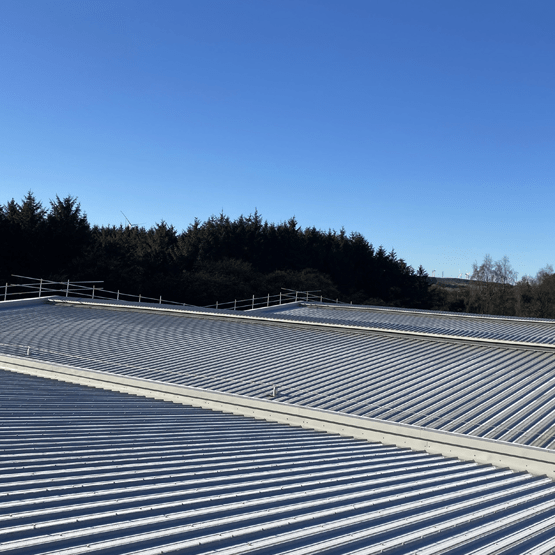
Two bonded warehouses needed new roofs, with asbestos insulating board fixed beneath the existing roof liner panels.

What we did

Roofing, design, scaffolding and SEAS worked as one programme, with licensed asbestos removal built into the roof upgrade.

Outcome

Both roofs were replaced and the project was completed without any accidents or incidents.

View the project profile

About this guide

Reviewed by SEAS, Starfish Construction's environmental and asbestos division. This guide is general information, not legal advice; check your own duties with the HSE or a qualified adviser. Last reviewed October 2026; next review October 2027.
Need advice on asbestos
in your building?
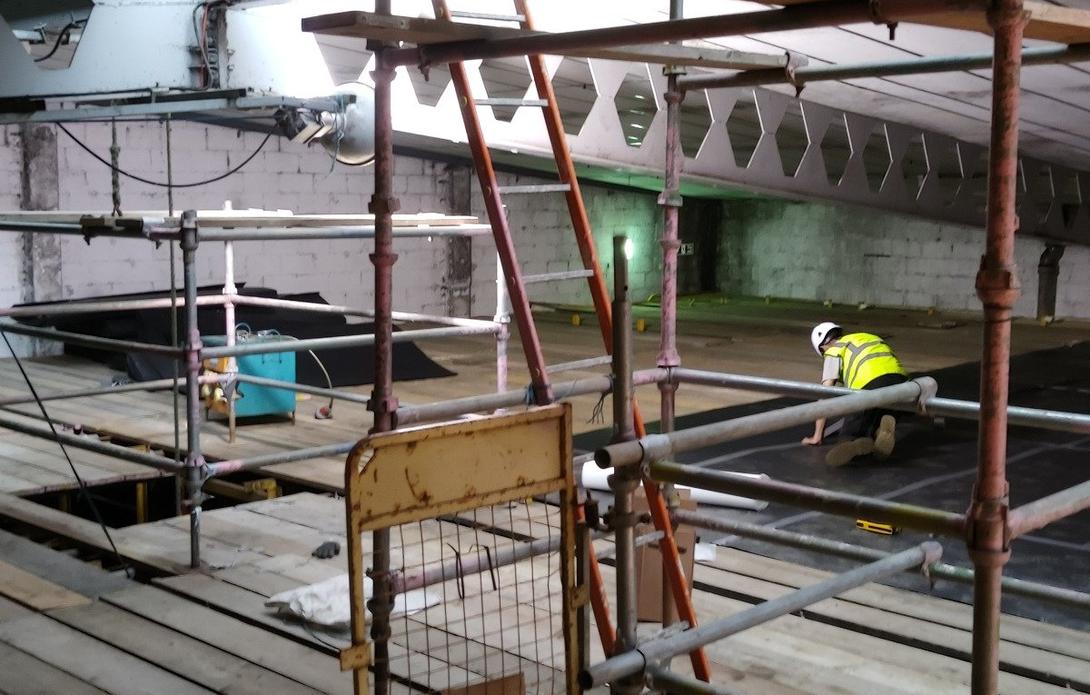
SEAS operative working on a scaffold during asbestos removal

Talk to SEAS about surveys, asbestos management plans, licensed removal and remediation for your building or site.